Reflections from His Eminence Metropolitan Nathanael
on the Sunday of the Blind Man and a Visit to Cook County Jail
As the Church now turns from the celebration of Pascha toward the coming feast of Pentecost, we are reminded that the Resurrection is not merely an event we commemorate, but a new way of seeing the world and one another through the life-giving presence of the Holy Spirit.
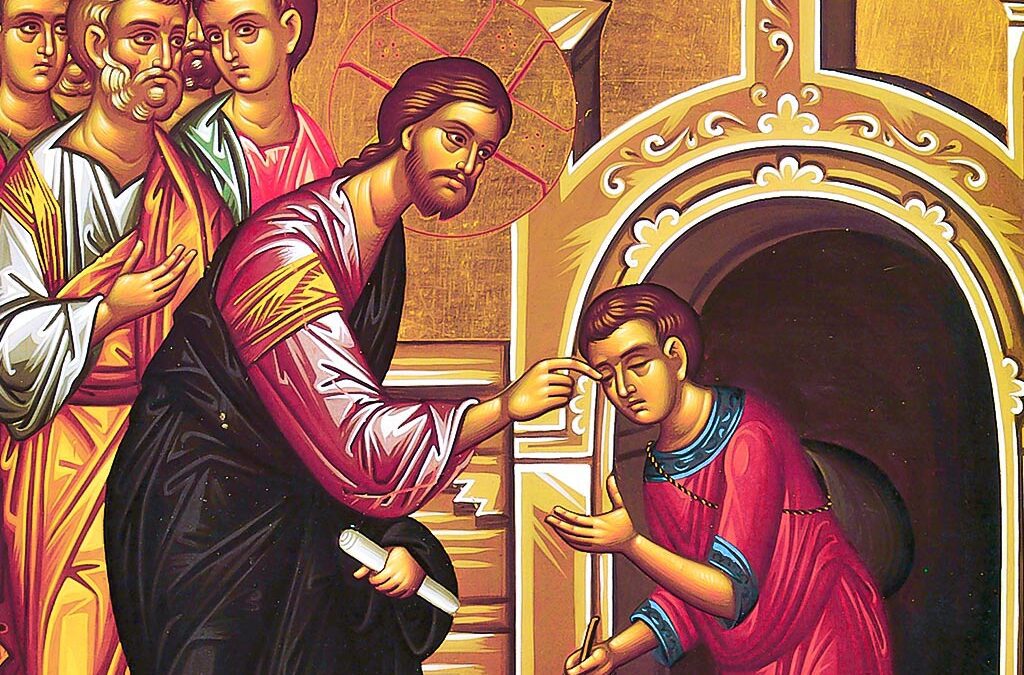
On the Sunday of the Blind Man, the Church proclaims one of the most beautiful encounters in the Gospel: Christ restoring sight to the man born blind (John 9:1–38).
What is striking in this passage is not only the miracle itself, but the way Jesus looks upon the blind man.
The disciples saw a problem to explain. They asked, “Who sinned, this man or his parents?” They reduced him to his suffering, his condition, and the assumptions they carried about him.
Christ did not.
Jesus saw neither a sinner nor a punishment. Where others saw a problem to judge, Christ saw one of His Father’s children standing before Him. The real blindness in this instance was not the man’s lack of physical sight, but the inability of others to recognize him as a beloved child of God.
This Gospel truth came alive for me recently during a visit to Cook County Jail.
There, I joined approximately a dozen incarcerated men for a gathering and time of prayer unlike any I have experienced before. As they entered the room, wearing the standard brown garments issued to them, many smiled warmly and greeted me with kindness. Some were young. Others were older. Some carried visible heaviness. Others radiated unexpected joy.
Standing among them, I realized again how easily we tend to define people according to their worst moments, failures, or the places in which they are confined.
We often use words that quietly reduce people to labels. Yet before any label, beyond any crime, and even beneath the weight of any sentence imposed upon them, these men remained beloved sons of God—men loved by Christ Himself.
This is not always easy for us to remember, especially when people have wounded others, wounded society, or even wounded us personally. Yet the Gospel continually calls us beyond labels and toward deeper spiritual vision.
In the Acts of the Apostles (Acts 16:16–34), we hear that Saints Paul and Silas were imprisoned after being beaten for preaching the Good News. Chained within a prison cell, they did not surrender themselves to bitterness or despair. Instead, “about midnight Paul and Silas were praying and singing hymns to God, and the prisoners were listening to them.”
Even in prison, they remained inwardly free.
Then came the earthquake. The prison doors opened. The chains were loosed. The guard, awakening to find the prison doors open, believed his life was over. Under Roman authority, he feared punishment, disgrace, and death. In despair, he prepared to take his own life.
At that moment, Paul and Silas did something extraordinary: instead of seeing only an opportunity for escape, they saw the human being trembling before them.
And so, Paul cried out, “Do not harm yourself, for we are all here.”
Paul and Silas refused to see the guard merely as their captor or enemy. They saw more than a guard standing before them. They saw a frightened son of God standing at the edge of despair.
The healing of the blind man, the imprisoned Apostles, and my own encounter within the jail all point toward the same truth: through the life-giving presence of the Holy Spirit, Christ continually teaches and invites us to see differently, even when our hearts resist that invitation.
The world often sees categories: prisoner, criminal, addict, enemy, failure.
Christ sees sons and daughters whom He continues to seek, love, and call toward Himself.
This does not erase accountability or the consequences of sin. But it reminds us that no human being should ever be stripped of their God-given dignity. No one is beyond the reach of grace.
As we prayed together in the jail, chanting hymns and reciting prayers, I was reminded that even in places marked by fear, regret, isolation, and shame, the light of the Resurrection continues to shine.
Perhaps the greatest prison is not made of steel doors or concrete walls, but the inability to see another person with mercy, compassion, and hope.
The blind man was healed because Christ saw him as a beloved son of God.
The guard was saved because Paul and Silas saw him as a brother.
And perhaps our own healing begins when the Holy Spirit illumines our eyes to see every person as a beloved child of God.
For when we begin to see others as Christ sees them, we begin at last to see clearly ourselves.