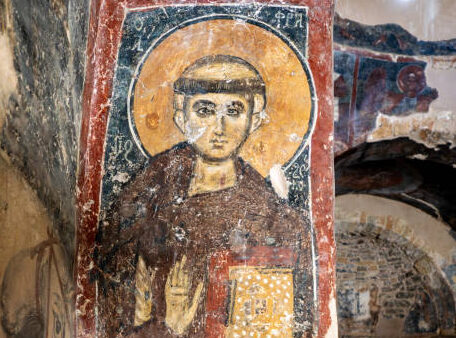
Fresco of St. Francis Assisi in the church of Panagia Kera in Kritsa, Crete
Lions and Lambs: Reflections on Courage and Mercy in Hierarchical Ministry
Some experiences change the way we view the world around us. Others transform the world within us.
Changing Hearts
Recently I had the blessing to undertake what I would describe as a fraternal pilgrimage with Cardinal Blase Cupich of Chicago. As bishops serving the same city—but in different Christian traditions—we felt it meaningful to visit one another’s historic centers of faith.
Our pilgrimage first brought us to Constantinople and then to Rome, where we were graciously received by His All-Holiness Ecumenical Patriarch Bartholomew and His Holiness Pope Leo XIV. These visits, along with the liturgies and conversations we shared along the way, provided a meaningful context for deeper reflections that would emerge during the journey.
What I did not realize at the time was that this pilgrimage would invite me to reflect more deeply on the paradox of Christian leadership: that a bishop must be bold in proclaiming the truth and gentle in caring for souls.
At the time I did not yet have the words for it, but I would soon discover that this calling often requires a shepherd to learn how to live with the heart of both lion and lamb.
Wise Discernment
During our travels I asked Cardinal Cupich a question that many bishops quietly wrestle with: how does one discern when to raise his voice publicly?
His answer was simple, but deeply wise. Before speaking publicly, he asks himself three questions:
- Is it truthful?
- Does it have to be said?
- Do I have to be the one to say it?
Only when the answer to all three is yes does he choose to speak.
Those questions stayed with me long after our conversation ended. They reveal something important about hierarchical leadership. The Gospel calls shepherds to proclaim the truth clearly and faithfully—but not every truth must be spoken at every moment, and not every voice must be our own.
Yet when the answer to those questions is yes—when something is true, when it must be said, and when the responsibility falls upon us—silence is no longer an option. In those moments, love itself demands that the shepherd must speak.
Francis’ Witness
After Rome, the Cardinal returned to Chicago, and I continued my pilgrimage to Assisi.
For some time, my heart has quietly longed to walk upon the soil where Saint Francis of Assisi once walked. Assisi is not merely a place where Francis lived long ago. It is a place where his spirit continues to breathe through the lives of the friars who follow his path of humility, fraternity, and prayer.
During my time there, the friars welcomed me warmly into their life of prayer and fellowship. Though our languages differed, their hospitality made me feel less like a visitor and more like a brother among them. In their simplicity and generosity, I encountered something of the spirit of Francis himself.
Francis intentionally chose a life of littleness and gentleness. He sought no worldly influence or authority, desiring only to follow Christ in humility and poverty. Yet these virtues did not make him timid or insignificant. On the contrary, his humility gave him remarkable freedom. Precisely because he was not seeking power or recognition, Francis was able to speak with extraordinary boldness—to fellow friars, civic leaders, church authorities, and even to the Sultan during the Crusades.
In the Life of Saint Francis, Saint Bonaventure describes him as gentle among the humble, yet fearless in reproving wrongdoing.
Francis understood something every shepherd must eventually learn: love requires courage.
Lion and Lamb
It was during my time in Assisi that one of the friars shared with me a phrase I have not forgotten:
A priest must be a lion in the pulpit and a lamb in the confessional.
In that moment I realized that the vocation of a shepherd is lived within this tension—to stand like a lion when proclaiming the truth of the Gospel, and to kneel like a lamb when caring for wounded souls.
Those words capture something essential about Christian ministry.
The Gospel must be proclaimed boldly and without compromise. Yet when people come wounded, searching, or repentant, they must be received with tenderness and mercy.
The Apostle Paul expresses this beautifully when he exhorts us to “speak the truth in love” (Ephesians 4:15). Truth without love injures. Love without truth deceives. But when truth and love converge, life emerges.
Episcopal Calling
If I am honest, there have been moments when I have fallen short of this calling. There have been times when fear—fear misunderstanding, loss, or even punishment—has made me hesitate when perhaps I should have spoken more clearly.
Saint Francis reminds me that authentic spiritual fatherhood carries both great joy and great suffering. To love others deeply is to risk being wounded by them. Yet the Scriptures remind us that faithfulness, not comfort, is the path of the disciple.
This pilgrimage reminded me that my calling as a bishop is not to seek the world’s approval, but to remain faithful to the Gospel entrusted to us by Christ.
Bishops are called to proclaim the Gospel courageously—even when doing so is difficult and may come at personal cost—and at the same time to receive every person with compassion, patience, and mercy.
I return from this pilgrimage praying that the graces I received—the wisdom of a brother bishop, the fraternity of the friars of Assisi, and the bold humility of Saint Francis—will help me become a more faithful bishop, accepting that a shepherd must sometimes be a lion in proclamation and always a lamb in mercy.